Curriculum Has a Current
Notes from a middle school.


I spent the morning at a middle school recently, watching three sixth-grade teachers each teach the same math lesson from Amplify Desmos Math. Those teachers and their work helped me understand that curriculum has a current and you’re either swimming with it or against it.
First, Here’s The Lesson
In the activity I watched—Order in the Class—every student received a card with a number on it.
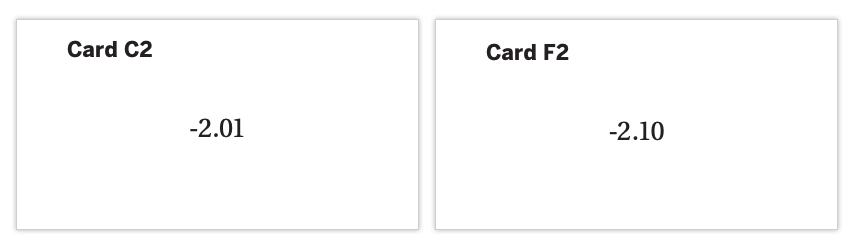
We didn’t choose these numbers randomly. Rather, we’re trying to invite and develop early incorrect ideas students frequently develop about numbers. For example, the idea that 9.45 is greater than 9.6 because it has more digits following the decimal.
Students had to move around the room and find other students with a number greater than theirs, with a sign opposite theirs, etc, and at the end arrange themselves in a single line from least to greatest. That last part was pretty spectacular to watch.
Why I Think This Lesson Worked
In my head, I played this lesson against a worksheet that had all the same numbers, with kids sitting and deciding if their number was greater or less than a bunch of other numbers. Certainly, kids who understood the math at a certain level could rip through that worksheet faster than the social experience.
The social experience seemed so much more effective, however, for a few reasons.
The paper can’t check you like your classmates can. Every new conversation about numbers is an opportunity to negotiate your ideas with others. Over time, you’re likely to find a person who disagrees with you. That’s a valuable check for understanding.
Negotiating your ideas deepens your understanding. The student who can rip through the worksheet should have to explain why 9.6 is greater than 9.45 and in doing so strengthening their own understanding.
Students aren’t suffering for worksheets in math class. They are suffering for opportunities to move and talk.
How The Teachers Swam With the Current
Every curriculum—every product and tool teachers use—has a current, an expression of how its creators think things are and ought to be. Sometimes that current moves quickly, reflecting very opinionated creators. Other times, when its creators are more agnostic, the current moves slowly.
I watched each of those three teachers find the current in our curriculum and start swimming with it. One of those currents is the conviction that students should become the curriculum, that at different points in a lesson student ideas should become objects of study for the class. I was happy, then, to see:
One teacher had a very effective way of saying, “I’m totally confused here,” and drawing out the class’s ideas in order to help unconfuse him.
Another teacher dealt herself a number card and played with the class.
The third teacher heard an idea from a student, one that was correct but imprecisely expressed, and stuck with it, studying the kid as the kid said, “So when the number gets bigger but the sign is negative the number is actually smaller.”
There are sometimes good reasons to swim against the current in your curriculum. Maybe the current fundamentally doesn’t suit you. You can always kick across or against it, but you won’t go as fast or as far as swimming with it. If I had to offer new teachers any advice in swimming with Amplify Desmos Math it would be this:
Sensitize yourself to the moments when students reveal their curriculum. A kid will say something that might seem out of bounds at first but which is actually working to stretch the boundaries of what we call math. In those moments, stay present. Express surprise, delight, or interest, even if it feels unnatural at first. Swimming feels unnatural at first. Ask the kid to say their thought one more time. Tell the class to tune in. Tell the class that something very interesting is happening that you want to understand better. Ask a second kid to restate the first kid’s thought even if just to buy yourself time to think. Ask the class to use their hands to signal whether they agree or have questions. You do not need to stay in this moment forever—just long enough to convince one more kid that they too might be the curriculum and to ready yourself for the moment when they share it.
This is how you find the current in our curriculum.
PS. On Tutoring
I have been working in the same eighth grade class every Monday all school year, generally with a group of boys who I can’t say enough good things about. They are energetic, outgoing, and kind to one another in ways that defy my expectations of eighth-grade boys. They also frequently need help with eighth-grade math, help which the state of California certifies that I can provide!
You might think, as I did, that this is a fantastic arrangement. But I have not found it easy at all to make that help available to these boys. Part of that difficulty results from the facts that this class speaks Spanish and all of those boys speak Spanish better than me, facts which I suspect have dimmed their impression of me. But another part of that difficulty is that the relational work of tutoring is just grinding, a mix of pushing (“¡okay ándale!”), prodding (“dígame más de este número aquí”), and encouragement (“¡estos estudiantes aquí ay!”).
Anyway, last week, the kid who kind of runs the group asked me what my name was. “What do I call you if I want your help?” he said.
“Mr. Dan,” I said.
There are four weeks left in the school year and I finally have—for now! tentatively!—enough trust and goodwill to help them with math.
I mention all of this as an invitation to anyone who feels excited about AI performing this tutoring work to help me understand the world as you do. What experiences have you had tutoring children that lead you to believe this is possible?
Upcoming Presentations
Let’s hang out this summer! At each of these events, I’ll be describing how to make math a more creative discipline for more students, and how to support teachers in that work.
Florida Association of Mathematics Supervisors. June 23, 2026. Jacksonville, FL.
Florida Council of Teachers of Mathematics Annual Conference. June 24, 2026. Jacksonville, FL.
Math in the Sun. July 1, 2026. Scottsdale, AZ.
Odds & Ends
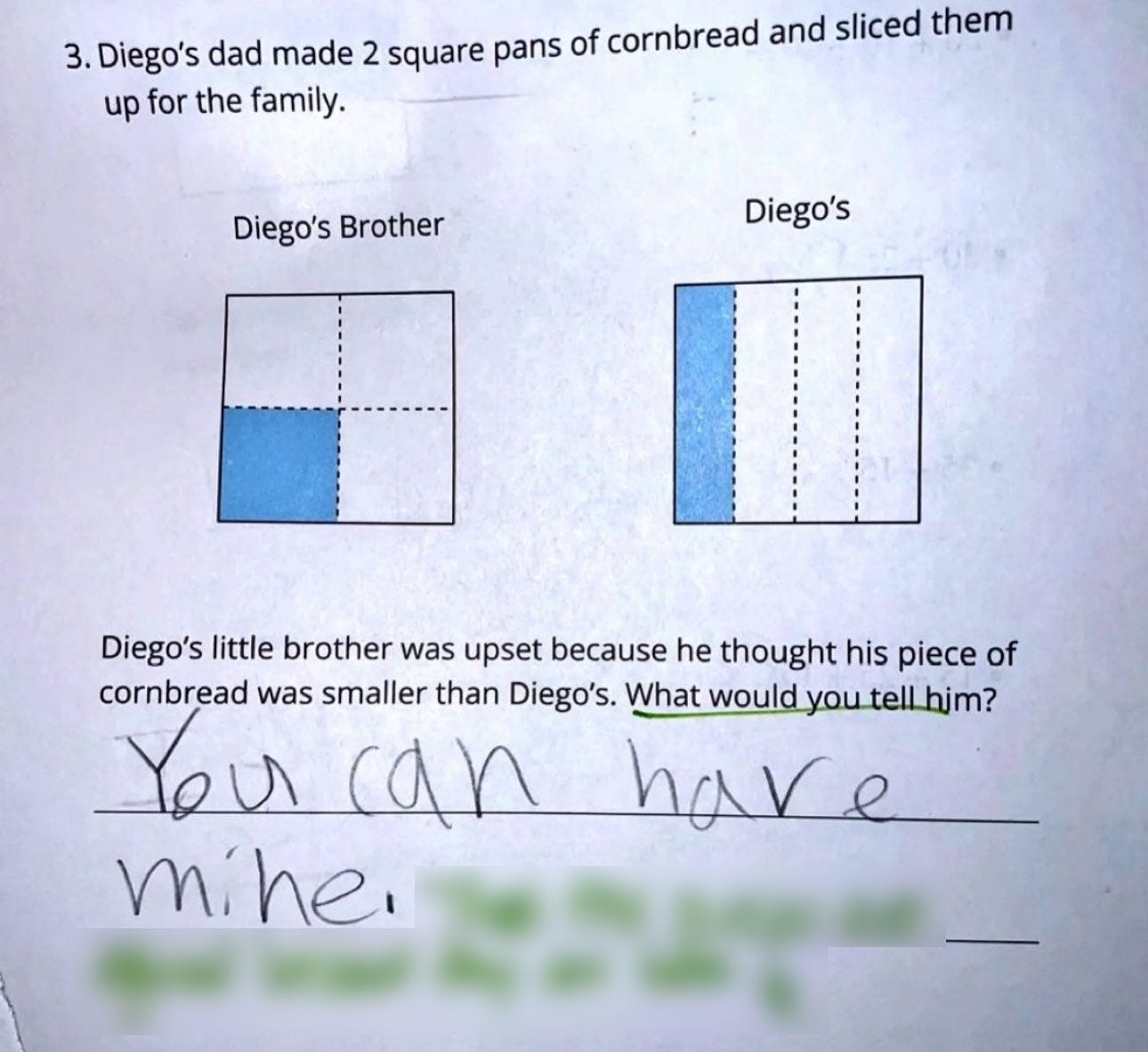
¶ I saw this somewhere on Twitter. What’s your move here if you see this answer? I’ll post the teacher’s response in the comments.
¶ I had a very nice chat with Craig Barton about maths and AI. He and I grew up as teachers at about the same time. We both turned social media into professional development. I think Craig and I are both generalists, preferring to make connections across teaching, math, and technology broadly without specializing maximally in any. I might have Craig wrong there, but for all of those connections, it was one of the most interesting conversations I’ve had about math edtech this year and, as a bonus, Craig recorded it. Here are his five takeaways from the conversation.
¶ A new YouTube channel from Amplify offers some awesome lil PD bites. Like, rate, and subscribe.
¶ Wisdom from Phil Hill:
If AI anxiety is what finally opens serious conversations about learning quality, institutional purpose, and the thirty-year drift toward transaction, that is worth something regardless of how the technology itself plays out.
¶ Great summary from Jill Barshay of research indicating that AI gives students different feedback depending on how the researcher described their gender and race.
The researchers found consistent patterns across all the AI models. Essays attributed to Black students received more praise and encouragement, sometimes emphasizing leadership or power. (“Your personal story is powerful! Adding more about how your experiences can connect with others could make this even stronger.”) Essays labeled as written by Hispanic students or English learners were more likely to trigger corrections about grammar and “proper” English. When the student was identified as white, the feedback more often focused on argument structure, evidence and clarity — the kinds of comments that can push writers to strengthen their ideas.
¶ Houston ISD is turning nine schools into AI-focused schools. What could that mean? “Minimal details have been released by the district as to the day-to-day instruction at Future 2 campuses.” Meanwhile, New York City put plans for a similar school on hold after parent outcry.
What the teacher said: "That the pieces are equal because they are both 1/4."
https://x.com/latentjuice/status/2051373595968909469?s=61
Feels like there needs to be a way to honor the sentiment and math both here.
You asked for people who are excited about AI tutoring to respond, and I'm the opposite, but here goes. I think a large amount of successful tutoring, like teaching, is building a relationship with a student, knowing their strengths, how and where to push them, etc. I just finished tutoring a girl I've worked with for 5 years (she's graduating 😢), and it was rarely the procedures she needed help with. What she needed was confidence, the time to talk through ideas, and reminders to check for the calculation errors she often makes when she rushes. I don't know how an AI tutor could provide those things (but I'm happy to hear about it if anyone thinks this is possible!).