Five Friends Help a Math Teacher Get Out of a Jam
Also: Alpha School's no good, very bad week.

I have made some very interesting friends in my time working in math education. Many of them have their own platforms, but many of them don’t, and I have started to feel selfish keeping their wisdom between them and me. So periodically, I’m going to ask them a question that’s bothering me, that I think should bother you, and report their thoughts back to you.
This Week’s Question
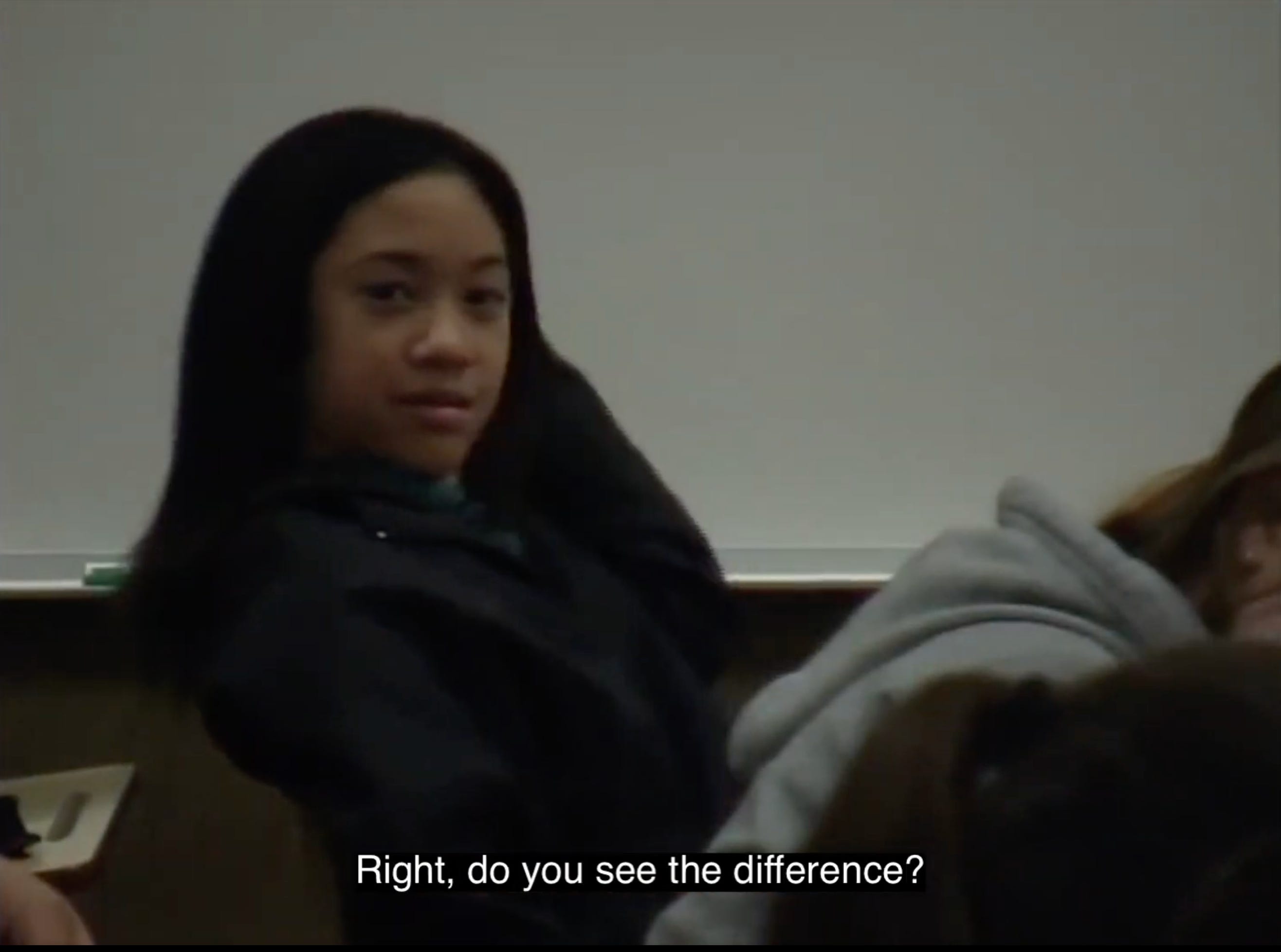
Here is a 30-second video of a teacher from the 1999 TIMSS study.
Teacher: Okay what if I say, “six less than a number.” Six less than a number. Michelle?
Michelle: 6-n
Teacher: “6-n.” What do you think, Aubrey?
Aubrey: n-6
Teacher: Why do you think that?
Aubrey: Um because …
Teacher: You’re right. Tell me why.
Aubrey: Six less than a number.
Teacher: Right, do you see the difference?
In that clip, a teacher is trying to help students understand how to convert English sentences into algebraic expressions. It really seems to me the teacher has found herself in a miserable kind of jam—one that I think is recognizable to any math teacher with >0 days of teaching experience.
What My Friends Said
First, I asked my friends to describe that jam
Shelley Carranza is a high school math teacher in Mountain View, CA, a former math teacher coach, and a former colleague of mine at Desmos and Amplify:
The dilemma is that we don’t know whether Aubrey and her classmates really understand why the answer is n-6 instead of 6-n. Aubrey looks doubtful at the end of the video, and now I’m curious to know how many students are in the same place as Aubrey, wondering whether they’ve got the order right.
Jenna Laib is a math coach in Brookline, MA, and has developed the idea of a “Slow Reveal Graph”:
The teacher seems to anticipate a potential misconception: that students may recognize “6 less than a number” as subtraction but follow word order when creating an expression, producing 6 - n instead of n - 6. The first student called on did exactly this. Rather than engaging with the response, the teacher seemed to invalidate it and ignore it, moving to another student who provided the correct expression.
Fawn Nguyen is another colleague at Amplify. She helps people imagine a transformative math program at their school and has also been a math teacher and teacher coach.
The dilemma: The teacher was listening for the correct answer in a way that’s “n minus six or death.” And I say this with full empathy—English is tricky, Dan. Tricky for Michelle, and hard for a perennial English learner like me too. I wasn’t even sure which expression was correct until the teacher confirmed Aubrey’s answer and I heard that it was simply the reverse order of what Michelle had said.
That’s it. Two common teacher imperatives are in tension here.
The teacher wants to know what kids know.
The teacher wants the thing kids know to be the right answer.
Those imperatives have created this jam where the teacher finds out that a kid knows a wrong answer and then moves onto another kid hoping to find the right answer, doing (I suspect) some damage to the first kid’s idea of math and of themselves as a mathematician. How can the teacher get out of this jam?
Shelley Carranza:
At this moment, I really want to write both expressions on the board, and celebrate what the students know about the problem. From there, I’d want to give students a chance to discuss how you could decide which was right, and make sure to elicit the strategy of testing specific numbers.
Marilyn Burns is a former teacher, an expert in K-12 math learning, and an author of (I’m estimating here) 1,000 books about learning math:
To write an expression that represents 6 less than a number, some students think it could be “6 – n” and others think it could be “n – 6.” Then, for both options: Turn and talk with your neighbor and then we’ll talk about it as a class.
Stephanie Blair has held every job there is in K-12 schools except (I think) cafeteria worker. She worked with me at Amplify and Desmos, and now supports schools as they adopt Snorkl:
Instead of asking what the answer is, give students 2–4 possible correct answers and then have them decide and defend which one is correct.
Jenna Laib:
Here are two ways this could have gone differently:
(1) Debate: elicit multiple responses from students. Accept them neutrally, and record them on the board to support discussion. The format encourages students to justify their thinking.
(2) Try it out: stick with the initial response of 6 - n, and test it with a number. What is 6 less than 10? Is 6 - 10 the same thing? Record everything on the board.
In both cases, the goal is to make student thinking visible and support justification of why an expression works.
As an editorial aside, this problem may have been avoided entirely if the students had been using mini-whiteboards, because then this particular teacher would not have called on the student with the incorrect response. However, I’d rather encourage rigorous engagement with all student ideas!
Fawn Nuguyen
Write both expressions on the board. Ask students to think quietly first: which one matches “six less than a number”? Then turn and talk to a neighbor. Then rate your confidence —100% or nah? Now convince me.
Your Turn
Exercise for you, the reader, who I also consider a friend:
What is common among all of my friends’ suggestions—both pedagogically and socially?
Each of my friends have identified a common pedagogical technique but they also share a certain understanding of the social relationship between teachers and students. They have different imperatives. Great stuff. Thanks, friends.
Featured Comment
Efrat Furst on my review last week of the Stanford AI+Education Summit:
I keep coming back to the MOOCs story, I just can’t figure out how people refuse to see how similar it is and learn the lessons. It was just 10 years ago, we were all here to witness the rise and fall.
Audrey Watters identifies the stakes here:
There will be no “AI” tutor revolution just as there was no MOOC revolution just as there was no personalized learning revolution just as there was no computer-assisted instruction revolution just as there was no teaching machine revolution. If there is a tsunami, it’s not technological as much as ideological, as the values of Silicon Valley -- techno-libertarianism, accelerationism -- are hard at work in undermining democratic institutions, including school.
Odds & Ends
¶ Alpha School, the $65k private school that claims to have replaced teachers with AI, had a no good, very bad week. 404 Media interviewed former employees and reviewed documents and found that Alpha School:
used AI to develop some sloppy, hallucinatory instructional materials,
generated those materials, in part, by scraping content from other curriculum providers (including my own company FWIW),
created clones of other edtech platforms like Khan Academy,
exposed webcam videos of students at public URLs.
Check my post on LinkedIn for a bit more commentary but, putting it plainly: Alpha School is speedrunning some of the worst excesses of the move-fast-and-break-things era. Even still, I think we should separate a few questions:
Is Alpha School pursuing their model of schooling in a sloppy, unethical way?
Who does this model of schooling best serve?
Is there anything the rest of us can learn from it?
#1 is, barring some kind of contrition from Alpha School, a settled question.
Michael Pershan wrote a piece about the second question that managed to get agreement from everyone—critics and proponents alike.
This is a school that believes that the “core” of schooling should be taken care of as quickly and painlessly as possible so that the rest of the day can be opened up to things that actually matter. Most schools don’t do this! We instead tell kids that history is a way of understanding ourselves and others. Math, we say, can be an absolute joy, full of logical surprises. We tell kids that a good story can open up your heart and mind. Alpha doesn’t.
Dylan Kane wrote a piece about the third question, arguing that, whatever we can learn from Alpha School, it isn’t anything about technology.
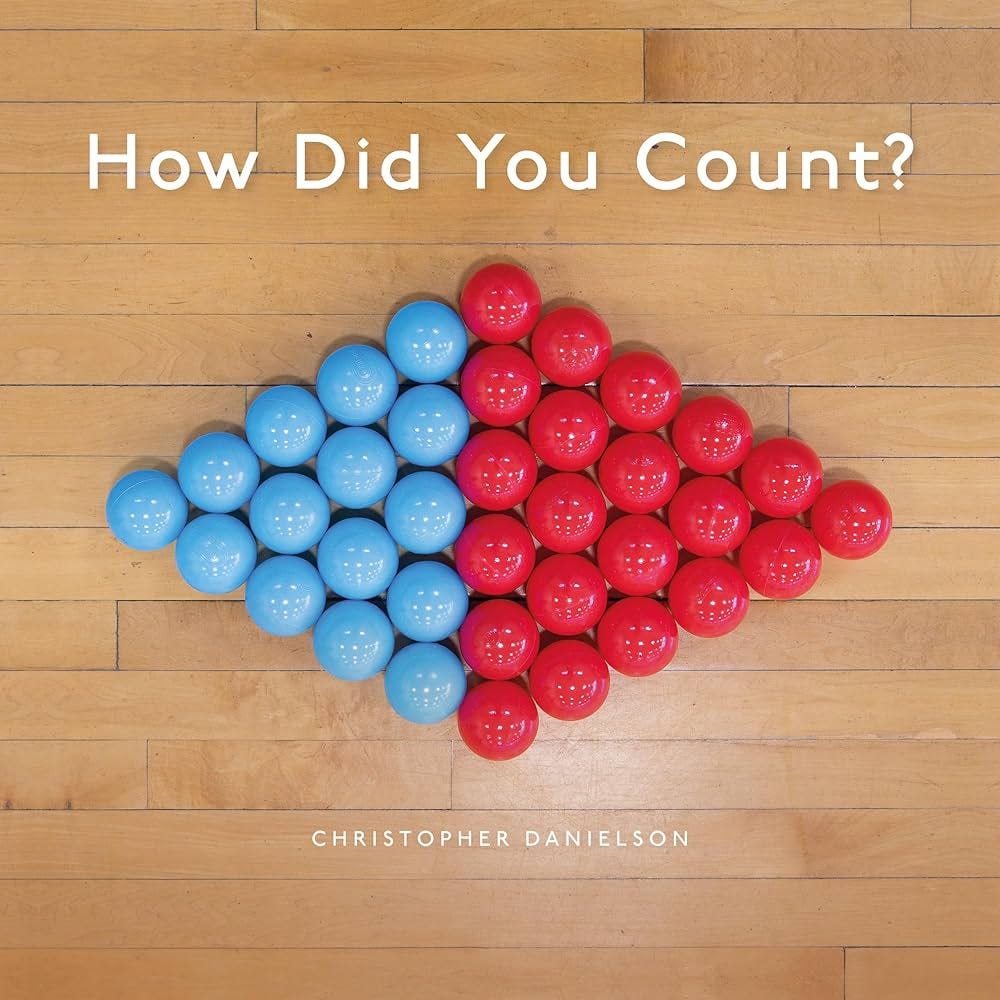
¶ Congrats to fellow Desmos and Amplify alum Christopher Danielson for winning his third Mathical Book Award. I have gifted How Did You Count and its beautiful photos of everyday mathematical collections to a bunch of my friends when they become parents.
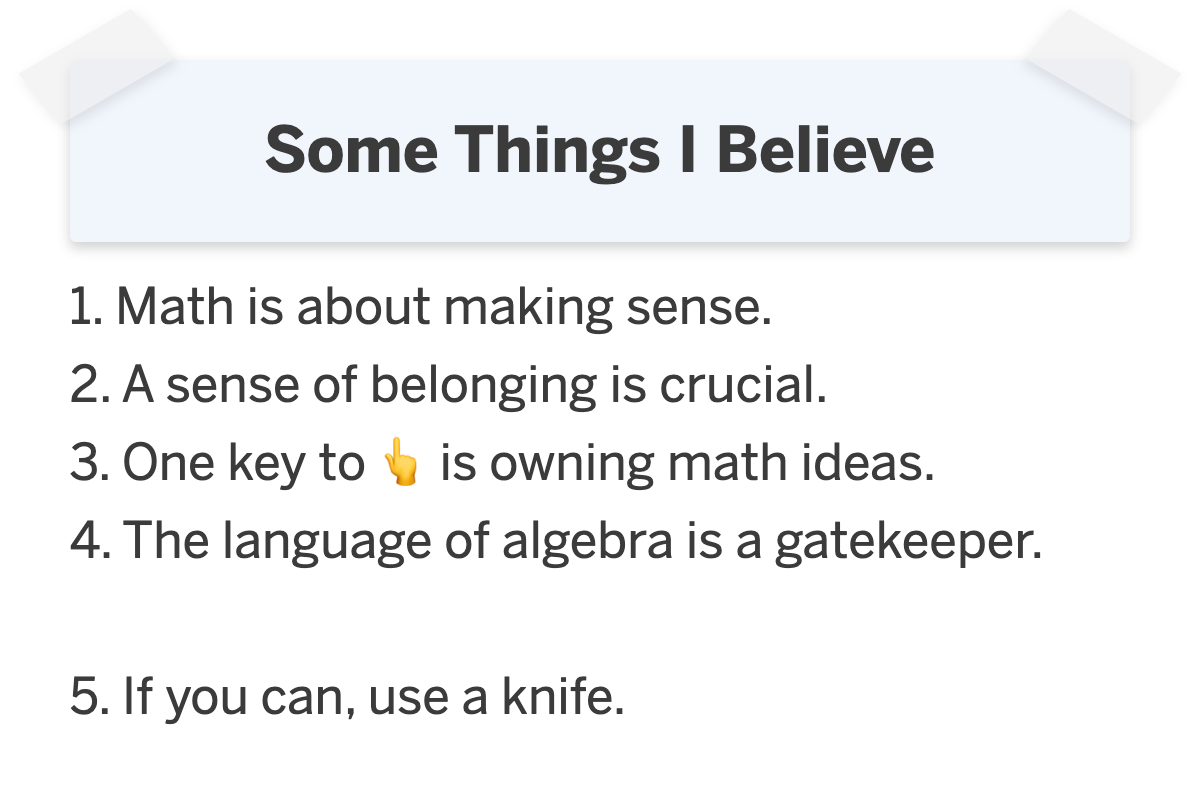
¶ Amplify colleague Shira Helft’s last statement of belief as a math teacher is cryptic and essential: “If you can, use a knife.” Read what she means.
¶ What happens when an AI bear hangs out with the AI bulls? Listen to my recent chat with Ben Kornell of the Edtech Insiders podcast.
Your prompt here is such a great PD exercise! It’s almost like how we would show students an incomplete or incorrect solution and ask them to improve it. I love how aligned their responses are even though these educators each have their own unique lens. At the end of the day there are universals to great teaching. I would love to see a bank of these types of prompts for teachers to work on their in-the-moment responses to student thinking.
There's a ritual that must have been established before this video, which is that the students seem to know that they are supposed to say "n" in their response when the teacher says "a number." All your friends converged on some version of the same remedy, which is to get the students to engage with what the expression means. But the ritual has already subverted that goal.