
Before I share a bunch of good teaching and good technology, would you toss me and my colleagues a vote on our SXSW sessions? Voting closes on Sunday. I’d be really grateful.
Improving the Teacher Experience w/ Alexandra Walsh
An Edtech Design System for Mathematical Belonging w/ yours truly.
Avoiding the Traps of EdTech’s Big Assessment Promises w/ Patrick Callahan

Yesterday, I watched Mike Goldstein and Reed Hastings talk about AI tutors. These conversations frequently jack up my blood pressure, with participants imagining that kids need something much less than they actually do or that computers can offer kids much more than they actually can. I was pretty happy, then, to hear Goldstein use his thousands of hours of observation of human tutors to articulate three differences between human and AI tutors. Here is one of them.
I think people often misconceive of tutoring as explaining. Sometimes that’s true … “hey today we’re going to learn about photosynthesis” … but a lot of times you’re trying to get the kid to blurt out the half-formed gray-mist idea in their head so that you can help clarify. They’re sort of stuck and you get them unstuck. AI is a very good explainer … but the behavior we see in randomized trials so far is the kid simply will not reveal their misunderstanding to the AI.
Introducing Itzel Silva
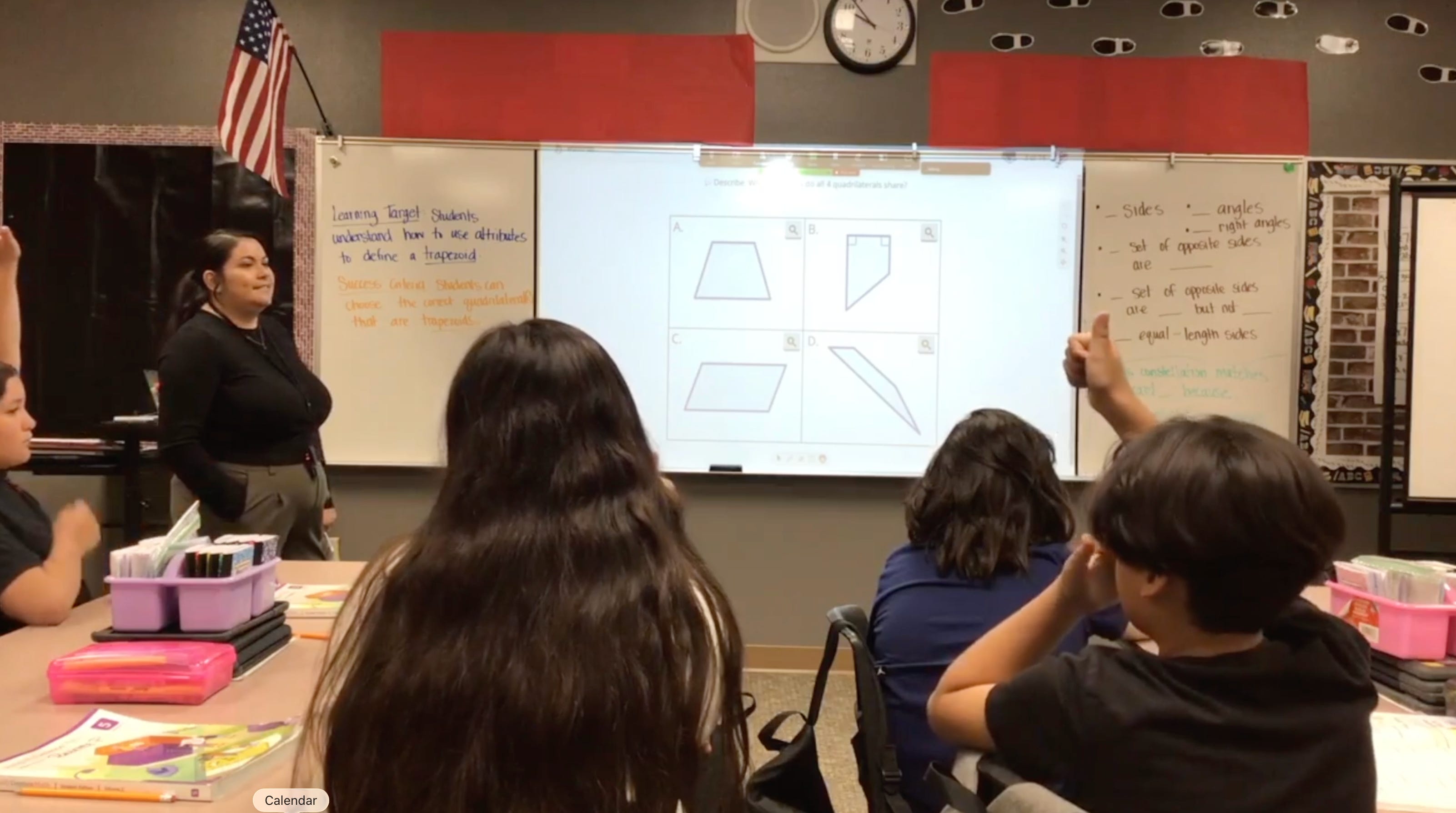
I want to introduce you to a teacher you might see more of around here. Itzel Silva is a fifth-grade math teacher in Arizona who agreed last year, along with the parents of her students, to share video of her teaching with us. She is using our Amplify Desmos Math curriculum, which does a very fine job of making room for a student’s half-formed gray mist ideas, but we need teachers like Silva to tell students, “hey, we made this room for you.”
“Enseñame con los manos.”
This is how you convince a kid, “it’s safe to share your half-formed gray-mist ideas.” This is how you go looking for half-formed gray-mist ideas across language boundaries, across the student’s conviction, sincerely held but always incorrect, that they don’t have any ideas about this math, fully- or even half-formed.
In this video, students are trying to define the difference between trapezoids and parallelograms, and also understand the process of defining families of shapes. Silva knows the student speaks Spanish and also notices the student using her arms to describe skew lines—lines that meet.
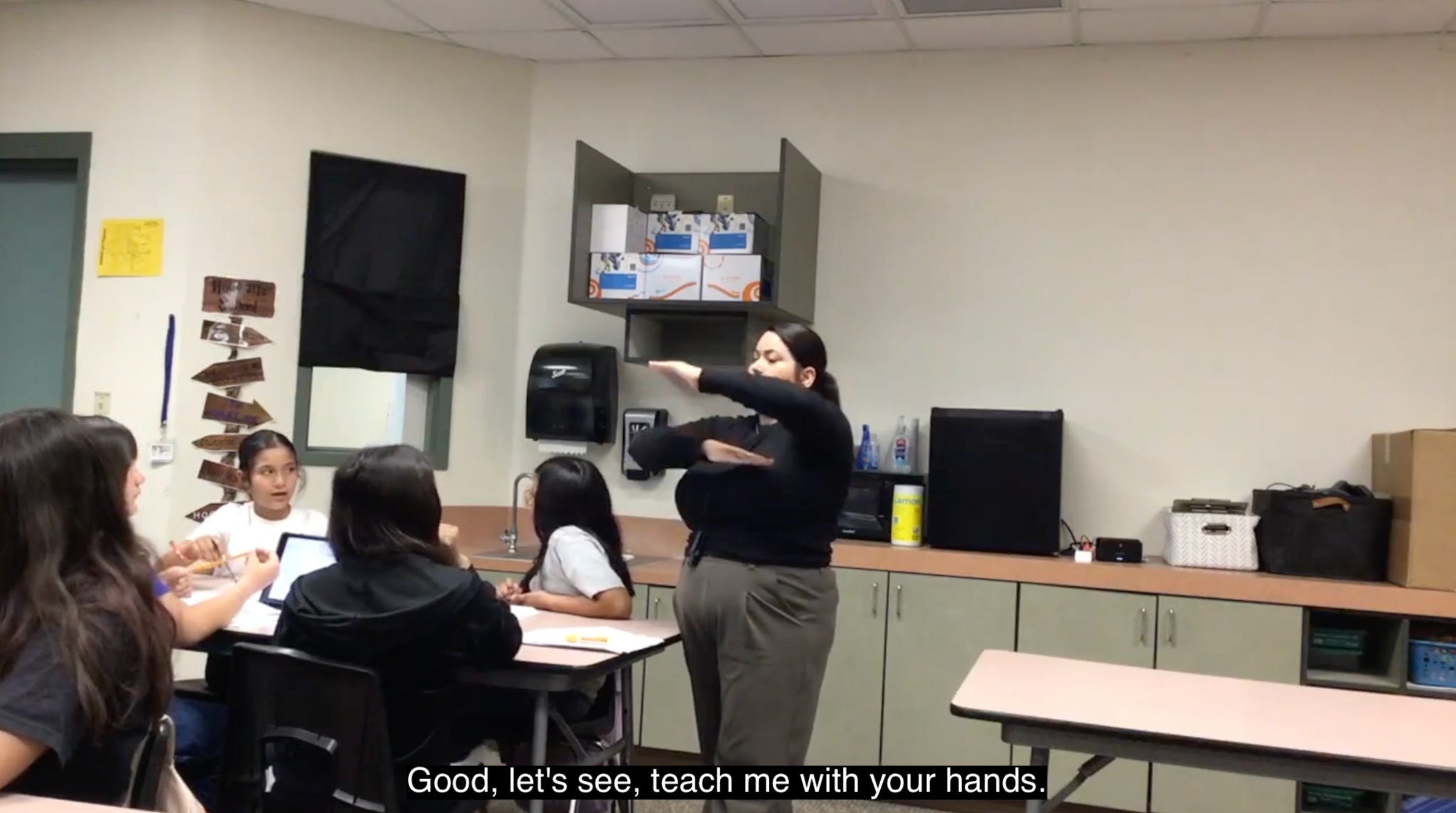
Silva wants to draw out the student’s half-formed gray-mist ideas about parallel lines so she uses the languages the student seems to speak comfortably—both Spanish and embodied—to clarify parallel lines. “Enseñame con los manos,” Silva says. “Show me with your hands.”
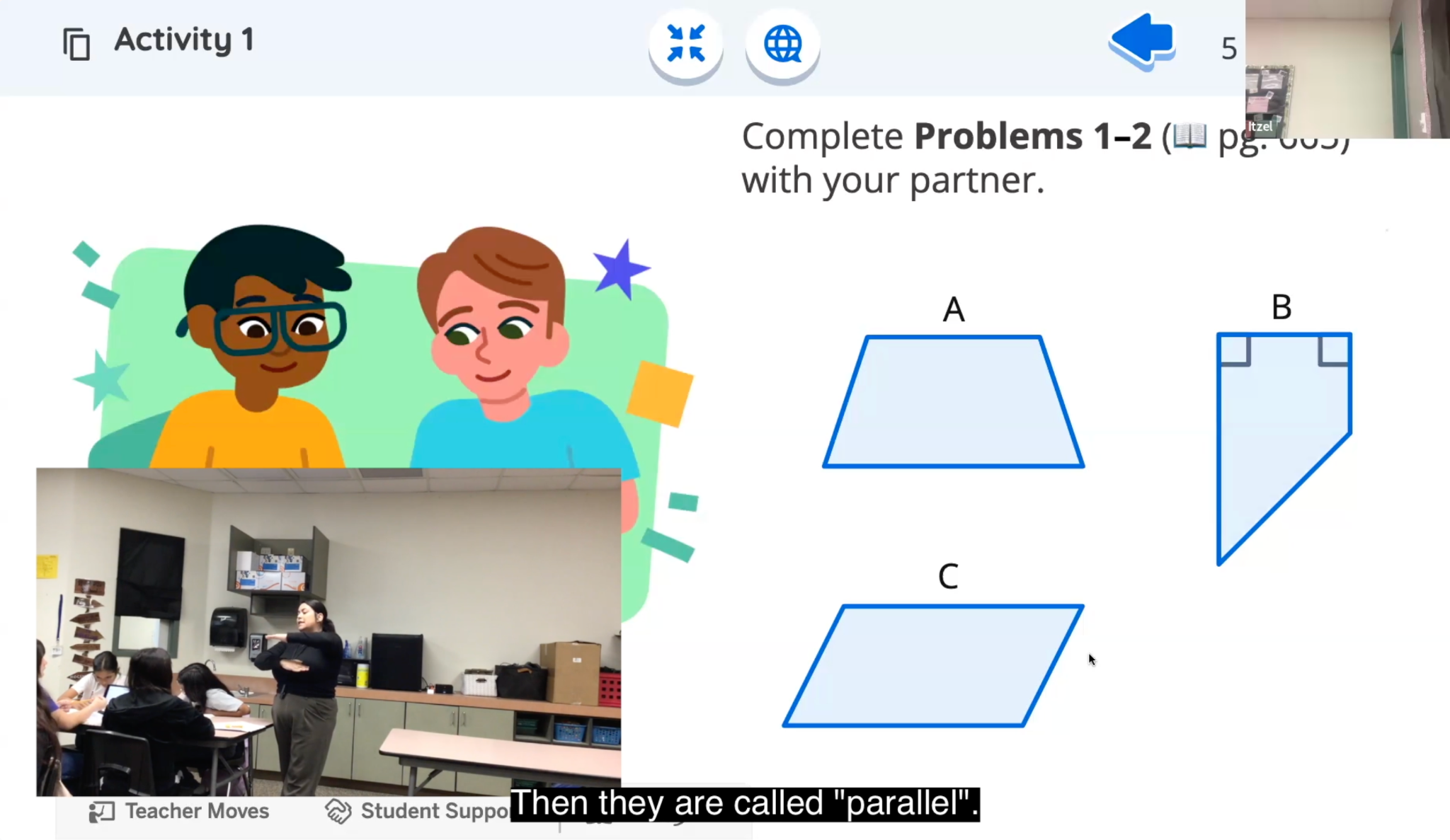
“They are called parallel,” Silva says to the kid. In doing so, Silva clarifies what the student knows partially, making whole what the student knows in part, adding words to what the student knows with her arms, giving form to the student’s gray mist .
If you’re a school leader, I think you can ask yourself a couple of interesting questions here. You can ask yourself, “At what point in the future will chatbot tutors offer my students even 5% of what Silva has offered her students?” You can also ask yourself, “What kind of experiences would help my teachers develop their practice like Silva has now?” One of those is a speculative bet about the future while the other acknowledges the needs of students and the capacities of teachers now.
Featured Comments
Edward Nevraumont, an Alpha School parent who wrote a popular review of the school at Astral Codex Ten:
This is the best critique of Alpha’s model I’ve read. Thanks for digging in on this. I hope MacKenzie and team respond and give some insight into what happened at Unbound.
Kalen asks why technologists so frequently misunderstand and disregard teachers:
The entrenched hostility in tech land to teachers is so strange and deep- is it just because it’s a care profession? Because it has soft skills they don’t like? Why is that the job that they’re so keen to put on the chopping block? So they do the whole 10x disruptor song and dance about how they’re gonna change the world, school in two hours- but then they define ‘school’ to mean ‘math ‘ (in which case two hours isn’t very surprising), toss the humanities in the dumpster in favor of ‘life skills’, and then charge winnowed rich kids enough to incidentally educate them the old fashioned way, which evidently they do, and then make headlines.
Shelbi Cole, on the cost of imagining that the selected students of Alpha School and the non-selected students of public schools are the same:
[Dan is] lifting up what happens when someone assumes that bowling balls and apples grow in the same orchard under similar conditions. Most of us aren’t surprised to learn that the bowling balls don’t grow here. This is a very hard lesson in generalizability and the victims are our children.
Notes From the Road
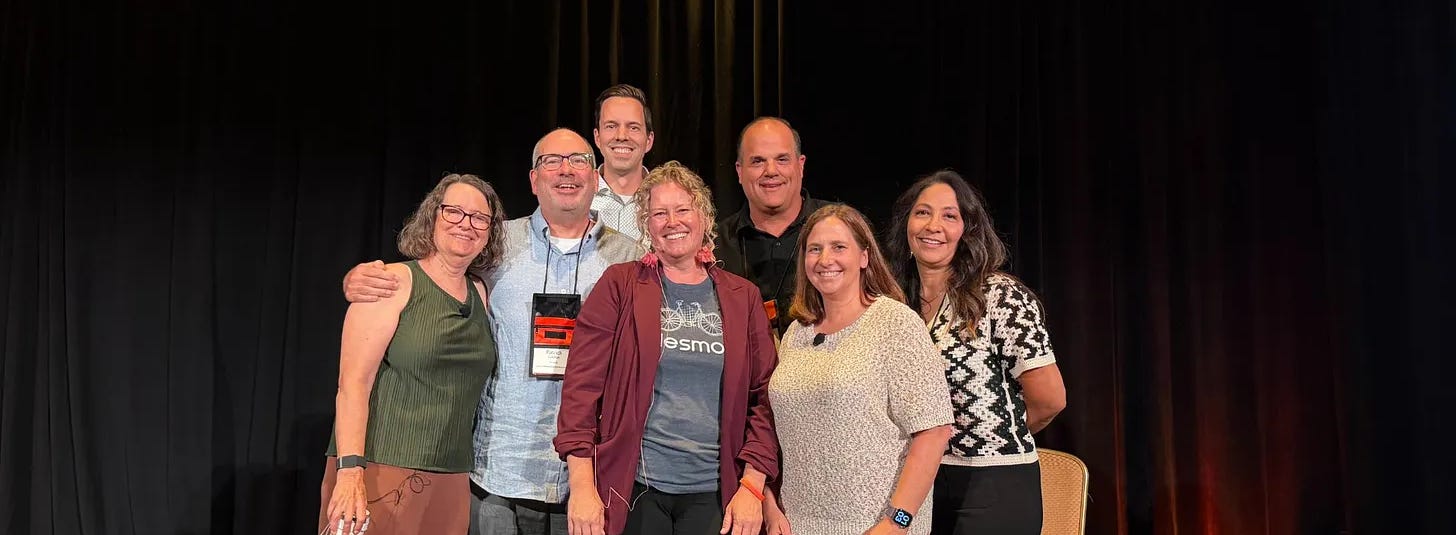
Earlier this month, I attended Amplify’s summer sales meeting in Scottsdale, AZ, and had the honor of moderating a panel of math leaders discussing the challenges of curriculum implementation and teacher development. Each leader described the power of small moments and small conversations—how a single idea from another teacher, how a single observation of a colleague’s classroom, how a single visit to another campus—unlocked a moment of profound local growth. How do we harvest those ideas? How do we make those interactions more common? Many thanks to Janet Hollister of Santa Barbara USD, Katrine Bryan from Lucia Mar USD, and Carrie Hair from Washoe CSD for those and other insights.
Odds & Ends
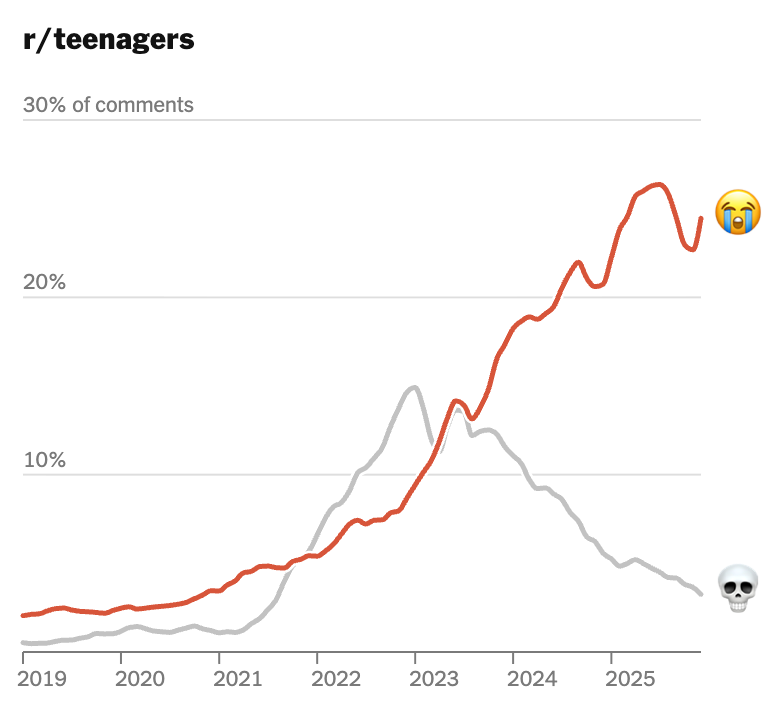
¶ Graph and culture lovers: please feast on this article from the New York Times on emoji popularity across time and within generational cohorts. I bought 💀 low but definitely held onto it for too long.
¶ Houston ISD is bringing the Alpha School model into some of its schools this school year but, curiously, only for students who are already high-achieving.
The state’s largest school district will launch a pilot program using “personalized” Alpha School learning modules for students who earn high scores on district reading and math assessments, according to the announcement
¶ We can all see that Sal Khan is subtweeting Alpha School here, right?
We’re seeing more and more schools succeed by leveraging technology thoughtfully. But that success is never about the technology alone. The teachers and administrators deserve most of the credit. And often these technology-enabled schools have other advantages that are hard to replicate.
¶ Here are five newsletters I don’t miss lately:
The Grade by Alexander Russo. Great roundup of education policy & industry news. Great interviews.
Mathematical Musings by Bill McCallum. Exploring the literature around math learning, problem solving, and direct instruction with the innocence of a puppy, digging deep into the citations and making connections between warring camps.
Connection Error by Julia Freeland Fisher. Every post contains a searing line or piercing meditation about the ways people interact socially through technology. Freeland Fisher does for generative AI what danah boyd did for social media.
Center for Teen Flourishing by Mike Goldstein . Quick, dashed-off articles that get me closer to the state of teens than anything since I taught them.
What We’re Reading by Whiteboard Advisors. A firehose of links, but the daily analysis above the fold is always well-written.
¶ Chalkbeat’s article on the AI slop taking over Teachers Pay Teachers has the single best kicker of any education article I’ve read this summer.
This example from fifth grade is drafting and revising happening in real time! Rough Draft Math in action. LOVE IT! (Of course I see the world through this lens...) Thanks for sharing.
I think often school leaders turn to AI tutoring bots or even just EdTech practice programming (IXL, Teach to One etc) because they feel cheaper and easier than developing good teaching. Teacher development is slow and requires systems that cultivate consistency like frequent observation and coaching, which equals time and effort. Edtech/AI products require a swipe of a credit card. Many of the programs offer training and make it feel like administrators can sit back and let the solution run itself. No effort, less time—it’s seductive.