“Math” “Teacher”
Two different depictions of two different math teachers.

Hey - I’m Dan Meyer and I write about math teaching and technology on special Wednesdays. Today, I’m sharing videos of two math teachers who I think can help us better understand the terrain of some of our debates about math teaching. Then some news from the world of education and technology
Many of our debates about the way math teachers should teach are what we might call “referred” debates—a debate whose true origin lies elsewhere. Debates that present as pedagogical—e.g., Direct or inquiry-based instruction? Team BTC or TLAC?—often mask debates about the nature of mathematics and the role of a teacher.
Consider, for example, these edits of two lessons from two teachers.
TIMSS Teacher
In this edited video of a teacher from the 1995 TIMSS Video Study, you’ll hear him frequently ask questions like, “Are you sure about that?” in response to a student’s incorrect answer.
Liz Clark-Garvey
Then consider this video of Liz Clark-Garvey teaching Grade 7 Amplify Desmos Math in New York City.
In that video, you’ll hear Liz say things like:
How would we use Tzameer’s method for Rectangle B?
I could be wrong but I think Saki is using Lizzie’s method.
I bet Gael is doing more of the Joely strategy.
You might think Lizzie’s method is more efficient. You can debate that. That’s fine.
How does each math teacher define “math” and “teacher”?
What good is a debate about their teaching techniques before confronting the different ways they both seem to conceive of the discipline of “math” and the role of a “teacher?”
Is teaching the work of instruction and evaluation? Is it the work of research and development? Are teachers also students? Is math a set of canonical, deductive ideas, each one falling naturally from the last like rain drops to the ground? Is math a set of dispositions and habits? An ability to recognize, name, and use patterns? A conviction that math must make a mark on me but I must also make a mark on math?
Perhaps “math” and “teachers” are all of those things, but I suspect you nodded more strongly at some of those questions than others. Our debates about “how” would lose a lot of their heat, I think, if we first defined the “what” and “why” of teaching math. It hasn’t done us much good, so far, pretending we all define “math” or “teacher” the same way.
Odds & Ends
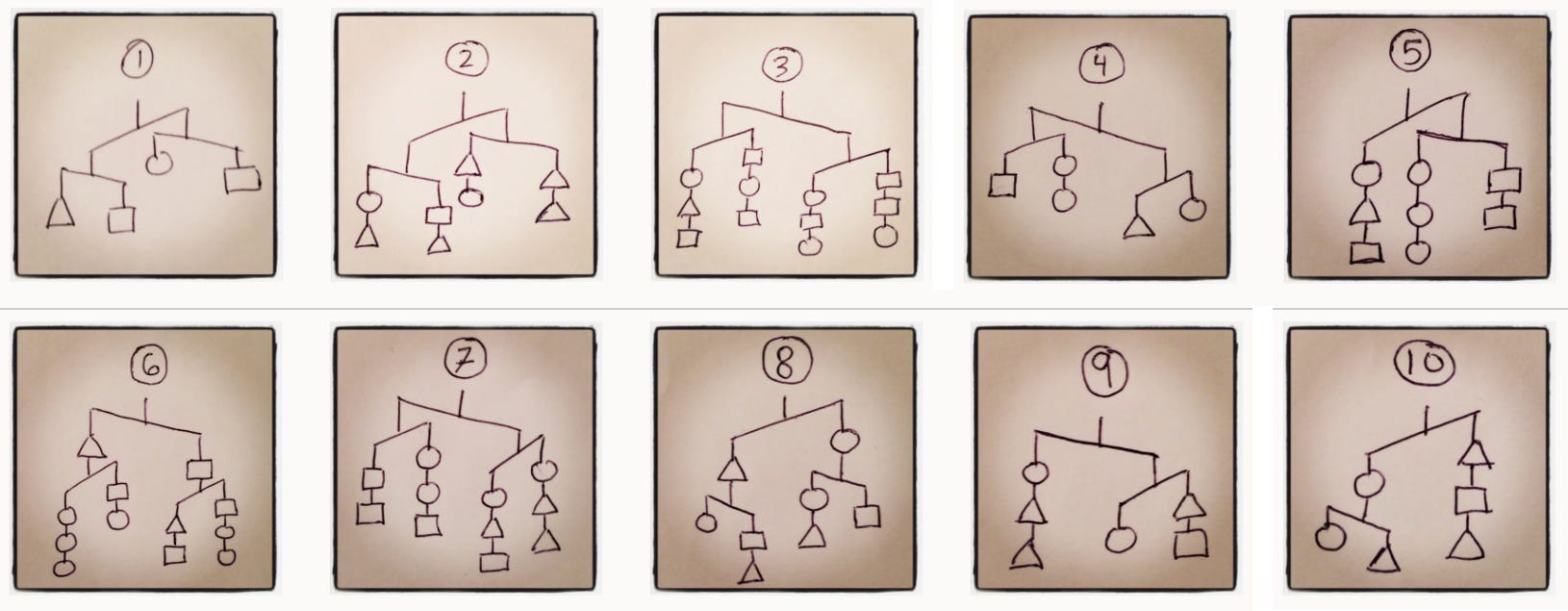
¶ Which shape weighs the most in each sketch? No numbers. No operations. Lots of math. Thanks to Michael Pershan for reminding me of this problem set from blog-era all-timer Paul Salomon.
¶ Here are some slides and handouts from Anand Bernard’s talk at Utah’s state math teacher conference last week. Who is Anand Bernard? No one I knew before last week, but I attended his talk and I liked it a lot. He and I nominally covered similar ground at UCTM—how to help students learn and love learning math—but Anand covered it on the level of classroom routines and rituals, which has never been a particular area of strength of mine.
¶ The DebateMath Podcast took on the question, “Is AI Helpful in Math Education?” Great guests and conversation. I’m still thinking about this line from Cal Armstrong (who was “pro” on the motion overall):
I can barely get the students to read the entire problem and now they want me to make them read the responses of a chatbot that never shuts up.
¶ The math education world needs more long-form writing, so I’m glad to see my Amplify colleague Shira Helft sharing hers. One of her non-negotiables about math teaching:
There is a lot of heated debate about what is important to teach and know in math, and why it matters in the first place. I don’t always know where I fall, but I do believe this: if the math that students are doing doesn’t make sense to them, something is wrong.
¶ AWu tried to understand teacher use of AI by researching online teacher communities and interviewing teachers. Their analysis is no less valuable for being anecdotal. I thought their description of “The Formatting Tax” was especially useful:
Every time a teacher reformats AI output, they are reminded that this tool doesn’t know my classroom. It doesn’t understand my context and it produces generic content, expecting me to do the translation.
¶ Khan Academy, Stanford University, and the University of Toronto just published a study of 200,000 students, their use of Khan Academy, and its effect on their learning. I think Sal Khan’s description is accurate:
The study finds a statistically significant link between Khan Academy use and student learning gains, even after accounting for student motivation, teacher effects, and what was happening in the classroom year to year.
And I also think Justin Reich is correct to poke at the practical significance here:
If 20 years and $100MM+ in research and development builds an online math practice problem system that supports typical learning gains of 0.03SD, what can we expect from other edtech products? What can we expect from AI improvements to edtech products?
[..]
It’s not nothing! Let’s celebrate the incremental gains where we find them! But man, we’ve been working on this online practice problem model for 40 years, and I’m not sure the ROI is panning out here. If we think AI can help, what’s your bet on the value add? If you think AI can make something like KA 2x better, which is probably impossible, then you are still measuring effects with microscopes. You really need to be getting 5x or 10x gains to see viability, which-just as with magical ponies-is very fun to imagine.
While I have a lot of criticism of Sal Khan’s broader vision for math, teachers, and students, I do think he and his team have taken the “online math practice” genre as far as anybody. And all of that energy and effort has amounted to a blip for the average student. What’s next?
Love. I spy my 'What is Math?' poster in Liz's classroom. I can't tell you how many of the conversations and at times disagreements in math world come back to us having different ideas of what math is or what it means to be a teacher. I once did a keynote titled "I teach math" where I talked about what each of these three words mean. Love your post.
Those unbalanced hanger diagram problems I will use with my students, thanks for sharing!