Everyone in Edtech Should Show Their Cards
Here are ours.

Wrap the pipes and cover the lawn chairs. It’s winter in edtech. Among other announcements and legislation nationwide, Los Angeles USD announced its draft plan last week for screens in classrooms. They’re planning to limit screen time for kids in grades 4–5 to 30 minutes per day, grade 2–3 to 20, and grade 1 and below to—nothing. Exceptions for testing and accessibility, but beyond that—nothing.
Every edtech executive with >1,000 followers on LinkedIn (including yours truly) has published their #NotAllEdtech post arguing that we should focus less on screen time and more on screen value. These companies all argue we should focus on how kids use their products rather than how much.
Many of those executives should be careful what they wish for. Indeed, to observe how many products are used in classrooms would only validate the fears of many parents—screens that pacify rather than challenge; screens that isolate rather than connect; screens that decrease rather than increase a teacher’s visibility into a student’s learning.
Show Your Cards
I’d like each of my colleagues to show their cards. I’d like to see from everyone engaged in this discourse: one (1) stationary video of a full classroom session.
Speed it up if you want, but that video will do more to illuminate the real-world social and cognitive impact of these products than any company-funded research study, customer testimonial, or LinkedIn post. Just show us how the pieces fit together, how the humans, ideas, and technology add up to more than the sum of their parts.
Our Cards
Here is a video of NYCPS teacher Liz Clark-Garvey teaching an Amplify Desmos Math lesson called Sand Dollar Search. As a treat, I have coded each segment of the video for “what the students are paying attention to.”
How Our Education Technology Works
At Amplify, we know that, yes, certain enterprising students can learn quite well from an LLM or a library card. But most students benefit enormously from the motivation, accountability, and support they receive from their teachers. We also know that if you ask students “why do you put up with school?” the vast majority of them will say, “Because it’s where my friends are.”
So we use technology as a loom and weave together people and their ideas.
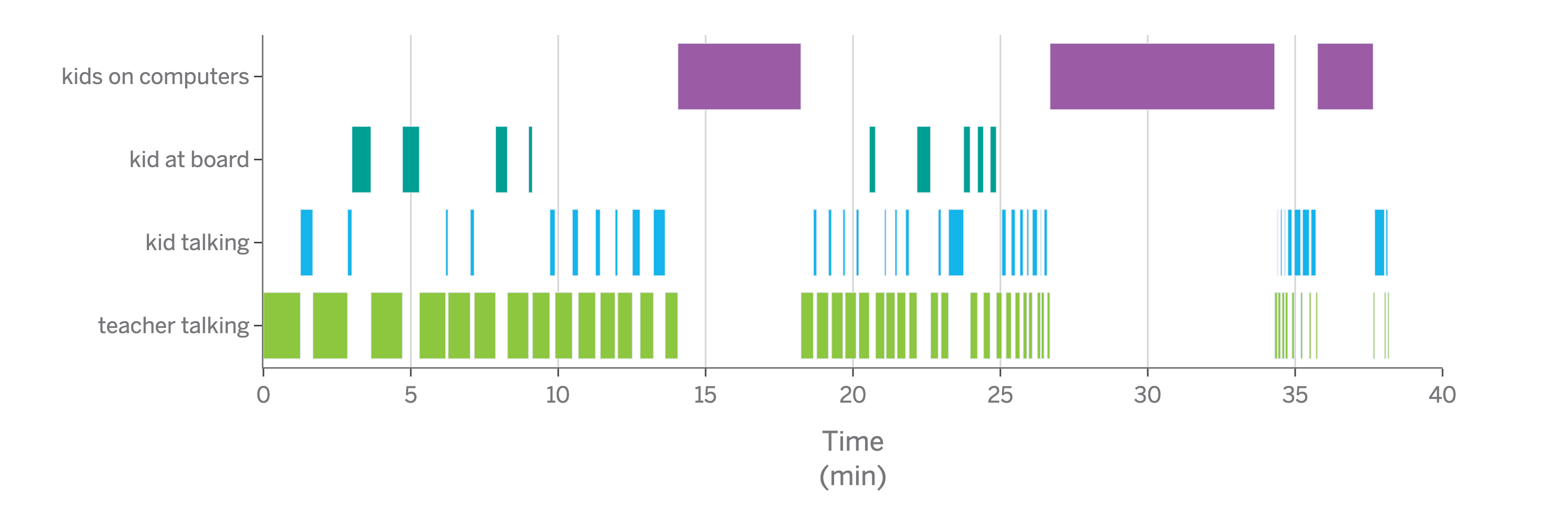
In Liz’s class, you’ll see students on their devices together. You’ll see them use those devices for short intervals—none longer than 8 minutes—13 minutes of screen time total. The devices first stir their thinking, letting them play with math in ways that are impossible with pencil and paper. Then the devices make that thinking visible to Liz who uses it in conversation with the whole class—calling kids to the board to elaborate their ideas, contrasting several ideas together, noting their similarities and differences, never speaking for longer than 90 seconds without checking in with students.
You’ll see students come to realize their work matters and react accordingly: working harder, participating actively, and learning more.
How Most Education Technology Works
Every edtech executive on LinkedIn seems willing to stuff at least one education technology into the wicker man and light it on fire. Everyone seems to agree that unrestricted access to YouTube is bad, for example. Everyone hopes this controlled burn will divert attention from their technology. Me, I hope the light from the fire helps everyone pay more attention.
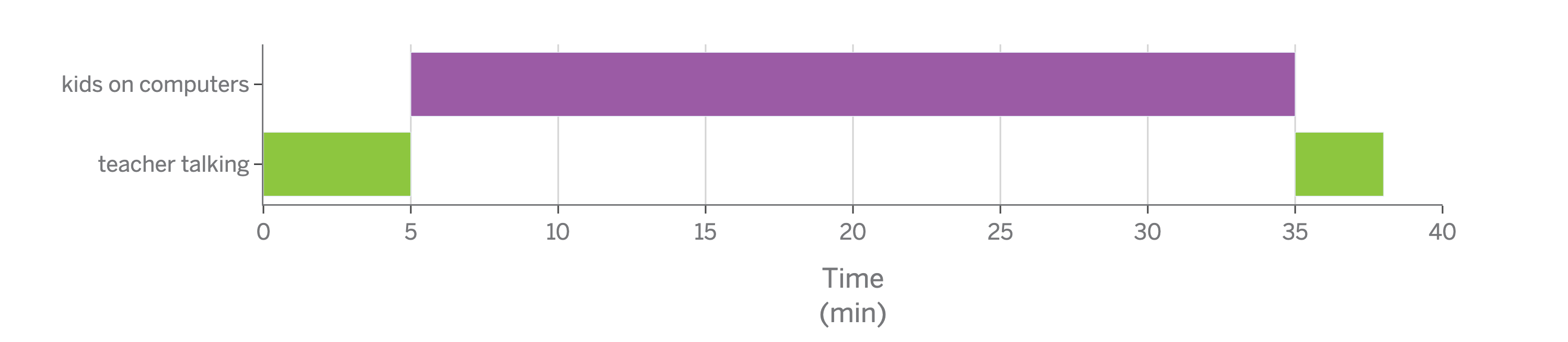
With lots of education technology, students spend too much unaccountable time on their devices. Everyone works on different things. The dashboard gives teachers limited visibility into that work. Kids know that teachers can’t easily check up on them. They come to realize their work doesn’t matter and react accordingly: drifting off task, onto other tabs, and out of any state parents would recognize as “learning.”
I’m an edtech developer and a parent of elementary school-aged students and I welcome greater scrutiny of our industry. After winter comes spring—a time of growth and renewal. Many edtech companies will try to survive this winter by warming themselves next to a fire that is right now consuming several of their peers. But they should show their cards—show a stationary video of a single classroom—and let parents decide whether or not to use their products for kindling as well.
Parents value the human relationships that schools produce, relationships that support student learning and human flourishing. Everyone in edtech should show their cards. Are they weaving those relationships together or pulling them apart?